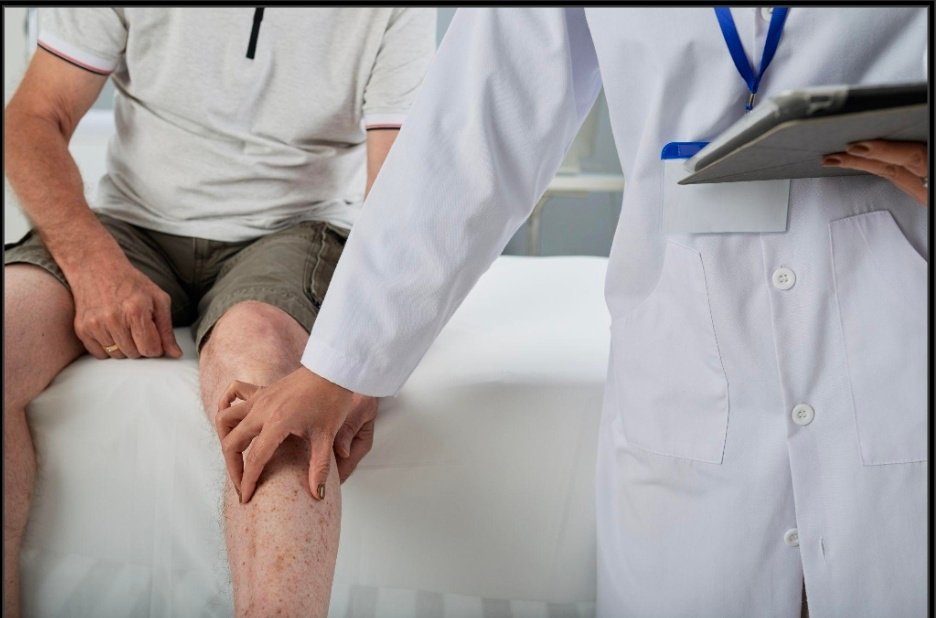
Knee replacement can be life-changing for people with severe knee pain, stiffness, and limited mobility. But before surgery, one question matters most: How successful is knee replacement surgery?
The knee replacement surgery success rate is generally favourable, with success often measured by pain relief, improved mobility, and the ability to return to daily normal activities. Long-term evidence suggests around 82% of total knee replacements remain in place at 25 years.
However, results can vary from patient to patient. So, what affects knee replacement outcomes? Let’s explore the seven key factors that can influence surgical success and long-term results.
What Is Knee Replacement — and Why Does the Success Rate Actually Matter?
Knee replacement surgery — also called knee arthroplasty — removes damaged cartilage and bone from the knee joint and replaces them with metal and high-grade plastic implants that recreate smooth, pain-free movement. It is the most commonly performed major orthopaedic procedure globally, with over one million surgeries performed annually.
The knee replacement surgery success rate is typically quoted as 90-95% — meaning most patients achieve significant pain relief, improved mobility, and restored function. But this headline figure conceals important variability. A patient who is the wrong candidate, operated on by a low-volume surgeon, with an incorrectly chosen implant, and who does not complete rehabilitation can have a very different outcome from someone for whom every factor is optimised.
Understanding what drives success — and what undermines it — is what this guide is about.
Who Should Consider Knee Replacement Surgery?
Knee replacement produces its best results — and highest success rates — in patients who genuinely need it. Correct patient selection is itself a success factor.
Strong candidates for knee replacement include:
- Patients whose pain significantly limits walking, stair climbing, or daily independence
- Patients who have consistently failed conservative management — physiotherapy, injections, and anti-inflammatory medication — over a meaningful period
- Patients whose quality of life is measurably impaired by the joint disease
Patients who should reconsider or delay:
- Active joint or systemic infection
- Severely uncontrolled diabetes
- BMI above 40 without prior weight management
- Patients whose expectations of returning to high-impact sport are unrealistic post-surgery
If you are in Noida or NCR and want an accurate assessment of your candidacy, knee replacement surgery in Greater Noida at Fortis Hospital offers comprehensive pre-operative evaluation to determine whether you are in the right category for the best possible outcome.
7 Factors That Directly Affect Knee Replacement Surgery Success Rate
Factor 1 — Surgeon Experience and Case Volume
The surgeon you choose has the single greatest influence on your knee replacement surgery success rate — more than the implant brand, the hospital tier, or any other variable.
Why Volume Matters:
Surgeons performing 100+ knee replacements annually consistently produce more precise implant alignment, lower complication rates, and higher patient satisfaction than low-volume practitioners — confirmed across multiple national joint registries.
What to Look For:
Fellowship training specifically in joint replacement, robotic surgery certification, and demonstrated subspecialty focus in arthroplasty — not just general orthopaedics.
Factor 2 — Implant Selection and Alignment Accuracy
The implant material, design, and — critically — its alignment within the knee directly determine how long it lasts and how natural it feels.
Alignment Is Everything:
A 3-degree malalignment of thel component increases implant wear rates exponentially. Robotic-assisted surgery reduces this alignment error to under 1 degree in most published series.
Implant Material Matters:
Premium crosslinked polyethylene bearings and oxidised zirconium femoral components show significantly lower wear rates compared to standard materials — particularly important for younger, more active patients.
Factor 3 — Pre-Operative Patient Fitness and Management
A patient who arrives at surgery in poor metabolic health consistently achieves lower success rates than one who is optimised — regardless of surgical quality.
Diabetes and Infection Risk:
Patients with HbA1c above 8 have a 2-3 times higher surgical site infection rate. Optimising blood sugar control before surgery is non-negotiable for protecting outcome.
Weight and Joint Load:
Every kilogram of excess weight adds approximately 3-4kg of compressive force on the knee implant. Patients who achieve even modest pre-operative weight loss show measurably better outcomes and implant longevity.
Factor 4 — Prehabilitation — Strength Before Surgery
Prehabilitation — building quadriceps and hip muscle strength before surgery — is one of the most underused success factors in knee replacement.
Why Pre-Op Strength Matters:
Patients with stronger quadriceps before surgery consistently achieve better range of motion at 6 weeks, return to independence faster, and report higher satisfaction at 12 months.
What Prehabilitation Involves:
A structured 4-8 week programme of supervised physiotherapy before surgery — targeting quad sets, straight leg raises, and aerobic conditioning to prepare the body for the demands of post-operative rehabilitation.
Factor 5 — Post-Operative Rehabilitation Compliance
Rehabilitation compliance after surgery is the factor most directly within the patient’s control — and the one most frequently neglected.
The Physiotherapy Window:
The first 12 weeks post-surgery are the crucial period for preventing scar tissue formation (arthrofibrosis), achieving adequate range of motion (90 degrees minimum at 6 weeks), and rebuilding quad strength. Patients who attend every session consistently outperform those who skip.
Patient Behaviour at Home:
Completing prescribed home exercises twice daily, maintaining correct sleeping position (avoiding knee hyperflexion), and attending follow-up appointments are the three patient-controlled behaviours most predictive of success.
Factor 6 — Realistic Patient Expectations
One of the most commonly overlooked factors in determining reported success rate is the alignment between what surgery can deliver and what the patient expects.
What Knee Replacement Does Well:
Reliably eliminates resting pain and mechanical joint pain from bone-on-bone arthritis. Most patients report their pre-surgical chronic pain is significantly better within 6-8 weeks.
What Knee Replacement Does Not Do:
Return patients to high-impact sports, eliminate all physical limitations, or feel identical to a native knee. Patients counselled on this pre-operatively consistently report higher satisfaction than those who arrive with uncorrected expectations.
Factor 7 — Hospital Infrastructure and Infection Prevention Protocols
The surgical environment in which knee replacement is performed contributes meaningfully to the knee replacement surgery success rate through infection prevention, anaesthetic management, and enhanced recovery protocols.
Laminar Air Flow and Sterile Precautions:
Hospitals with dedicated orthopaedic theatres using laminar airflow systems, prophylactic antibiotic protocols, and infection surveillance programmes consistently show lower peri-prosthetic infection rates than general surgical environments.
Enhanced Recovery After Surgery (ERAS) Protocols:
Modern & Advanced ERAS programmes — multimodal analgesia, early mobilisation, controlled fluid management, and rapid discharge planning — reduce complications and accelerate functional recovery across all age groups.
To understand more about how these factors specifically influence robotic surgery outcomes in India, the success rate of robotic knee replacement in India provides detailed, evidence-based context on what modern techniques achieve versus traditional approaches.
Myths and Facts About Knee Replacement
| Myth | Fact |
| “Knee replacement is only for the very old” | Surgeons recommend it based on joint damage and function loss — patients in their 50s frequently benefit |
| “The surgery is extremely painful” | Modern multimodal analgesia protocols control pain effectively — most patients rate post-surgical pain at 4-5/10, lower than pre-surgical chronic pain |
| “Implants last only 10 years” | Modern implants in well-selected patients have 15-25 year survival rates above 90% |
| “You won’t be able to do much after surgery” | Most patients return to walking, swimming, cycling, and social activities — high-impact sport is the exception |
| “Recovery takes a year” | Most patients achieve functional independence within 6-8 weeks and return to normal daily activities by 3 months |
Modern vs Traditional Knee Replacement — Which Delivers a Better Success Rate?
This is a question patients increasingly ask — and the evidence is now sufficiently robust to answer it:
Traditional (manual) knee replacement: Highly effective with experienced surgeons. Implant alignment depends on surgical judgement and manual instrumentation — alignment outliers are the primary long-term failure mechanism.
Robotic-assisted knee replacement: Computer-guided planning using patient-specific 3D CT models produces alignment accuracy within 1 degree — reducing alignment-related failure and improving soft tissue balance. Studies consistently show higher patient satisfaction at 5 years.
The verdict: For most patients — particularly younger, more active patients and those with complex anatomy — robotic-assisted surgery offers a statistically meaningful improvement in the knee replacement surgery success rate. The choice should be made collaboratively with a surgeon who has genuine experience with both approaches.
Dr. Bharat Goswami — Best Orthopedic Surgeon in Greater Noida performs both conventional and robotic-assisted knee replacement at Fortis Hospital, Greater Noida, with a patient-first approach to choosing the most appropriate technique for each individual’s anatomy and goals.
Frequently Asked Questions
1. What is the best age to have a knee replacement?
Most knee replacements are performed between 55-75 years, but age alone is not the criterion — severity of joint damage, functional limitation, and failure of conservative treatment are the primary indicators. Younger patients with severe disease are increasingly offered robotic-assisted replacement for better longevity.
2. How painful is knee replacement on a scale of 1 to 10?
With modern multimodal pain management, most patients rate immediate post-surgical pain at 4-5/10 — significantly lower than the 7-9/10 chronic pre-surgical pain many experienced. Pain reduces substantially by week 2-3 and is minimal by week 8-12.
3. What happens 20 years after a knee replacement?
Modern & Advanced implants in correctly selected and aligned cases show over 80-85% survival at 20 years. Some patients require revision surgery after 15-20 years due to gradual polyethylene bearing wear — a planned, manageable procedure distinct from failure.
4. What is the biggest complaint after knee replacement?
The most common complaints are temporary stiffness in the first 6-12 weeks and the knee feeling “different” from a natural joint. These are addressed through physiotherapy and realistic pre-surgical counselling. Constant unexplained pain affects approximately 5-10% of patients and warrants clinical investigation.
5. Can I live a normal life after knee replacement?
Yes — most patients return to walking, driving, travelling, swimming, cycling, and full social participation within 3-6 months. The goal of surgery is precisely to restore the daily life that severe arthritis had taken away.
6. What can you never do again after a knee replacement?
High-impact activities — running, jumping, and contact sports — are permanently discouraged to protect implant longevity. Deep squatting and kneeling should be avoided in the first 3-6 months and approached cautiously thereafter.