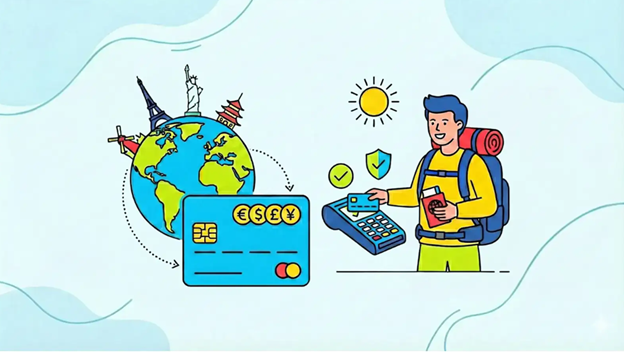
Have you ever wondered why so many travellers still face payment hassles abroad, even with a forex card? You load it, pack it, and assume it will work everywhere, because that’s what it’s supposed to do, right? Yet countless travellers still find themselves dealing with declined payments, unexpected fees, and confusing currency conversions right when they need smooth transactions the most.
The truth is simple: forex cards are not as “set-and-forget” as they appear. Behind their convenience lies a mix of hidden charges, unpredictable conversions, ATM surprises, and rules most people never read. And the tricky part? These mistakes usually become visible only when you’re already outside your home country. The good news? Most forex card problems are completely avoidable if you know what to watch out for. So let’s break down the 10 biggest forex card mistakes travellers make.
Loading your forex card at the last minute
Exchange rates fluctuate every day. Loading your forex card at the airport counter or right before your trip is one of the easiest ways to lose money. When you’re in a rush, you don’t compare rates, and that’s when you get hit with:
- Elevated exchange margins
- Hidden fees
- Lower conversion rates
If your goal is to send money overseas, pay hotel deposits, or make big-ticket purchases abroad, last-minute loading can completely throw off your budget.
Not checking hidden fees and markups
The biggest myth? Forex cards are “zero-fee” instruments. Reality? There are many charges one must look out for. Some of them include:
- Cross-currency conversion fees
- ATM withdrawal charges
- Reload fees
- Balance inquiry fees
- Inactivity charges
If you don’t read the fine print, you’ll pay more than you planned, even when you transfer money overseas or swipe at POS terminals.
Using a forex card in a currency you haven’t loaded
Using a forex card in a currency you haven’t loaded can turn into an unexpectedly costly mistake. For example, if you’ve loaded USD but end up paying in Euros, the bank will automatically convert the amount at its own rate, which is often far from favourable. This leads to higher exchange markups, additional conversion fees, and a final payable amount that can catch you completely off guard. If you plan to shop, dine, or enjoy experiences across multiple countries or currencies, these extra charges can add up faster than you expect.
Relying solely on your forex card
Relying solely on your forex card is one of the most common mistakes travellers make. If your card gets blocked, damaged, or simply isn’t accepted by a merchant (which happens more often with prepaid forex cards), you’re instantly left without a way to pay or even send money overseas in an emergency.
Thus, always carry at least:
- One debit/credit card
- One digital payment option
- A little cash
Not accounting for ATM withdrawal fees
Not accounting for ATM withdrawal fees is another costly oversight. Many travellers don’t realise that using a forex card at an ATM often triggers multiple charges like issuer bank fees, acquirer bank fees, and additional cross-border costs. Even if you’re simply trying to transfer money overseas or withdraw cash for local expenses, these stacked fees can quickly eat into your travel budget without you noticing.
With modern alternatives like Niyo’s international debit and credit cards, travellers get far more transparency and control. It helps them avoid unnecessary ATM surprises and manage their spending more efficiently.
Misplacing your forex card and not having backup access
If you lose your card and don’t have immediate access to emergency support, you’re likely stuck. Most traditional forex card issuers:
- Take time to respond
- Require lengthy verification
- Cannot issue instant replacement cards abroad
This can leave you helpless when you need to send money overseas quickly or pay for essentials.
Not checking whether your card is accepted everywhere
Not checking whether your forex card will be accepted everywhere can turn a simple payment into a travel headache. Many travellers are surprised to learn that prepaid forex cards often fail at small local stores, roadside restaurants, transport kiosks, highway tolls, online booking sites, and even some contactless terminals. You only realise this after a string of awkward declines, usually when you need to pay quickly. A little awareness upfront can save you from a lot of on-the-spot frustration abroad.
Ignoring expiry dates and reload restrictions
Forex cards have strict validity periods. If they expire during your trip, or shortly after, then you may face issues like:
- Inability to reload
- Inability to withdraw the balance
- Lengthy refund processes
And if you urgently need to transfer money overseas, an expired card becomes an instant roadblock.
Forgetting to unload the remaining balance
Forgetting to unload the remaining balance on your forex card is a small oversight that can cost you big later. Once you’re back home, it’s easy to ignore whatever amount is left on the card, but banks don’t. Many charge:
- Inactivity fees
- Offer poor reverse-conversion rates
- Delay refund processing
You lose money simply because you didn’t unload it on time.
Assuming forex cards are the best way to pay internationally
This is the biggest misconception. While forex cards were revolutionary once, the truth is that:
- They come with limitations
- They are costly in many scenarios
- They lack flexibility
- They aren’t truly global
- They fail during multi-currency travel
Today, travellers expect:
- Seamless payments
- Stronger security
- Better exchange rates
- Real-time app control
- Zero hidden fees
- The best way to send money overseas in emergencies
Traditional forex cards were not built for this digital-first world.
What’s the smarter alternative?
Modern, zero forex markup cards like Niyo are the solution to the issues above. Niyo offers international debit and credit cards with:
- Zero forex markup
You pay exactly the network rate, with no hidden fees.
- Globally Accepted
Perfect for POS, online transactions, ATM withdrawals, hotels, tours, everywhere Visa and Mastercard work.
- Multi-Currency Freedom
No need to pre-load different currencies. You load in INR and can use it in 180+ countries with no conversion charges.
- Real-Time App Controls
Lock/unlock card, manage limits, get instant transaction alerts.
- Safe, Secure & Travel-Ready
Your card stays protected with advanced security layers.
- Perfect for Emergencies
Need to send money overseas? Niyo’s digital-first ecosystem lets you handle payments without the friction of old prepaid systems.
With these advantages, Niyo truly represent the best way to send money overseas while travelling, without worrying about conversions, loads, reloads, or surprise fees.
Final thoughts
Travelling internationally should be about experiences, not expenses. But if you rely solely on traditional forex cards, you might end up paying more than planned, due to hidden fees, restrictive policies, conversion losses, and emergency limitations.
Today’s travellers choose smarter, globally accepted, zero markup alternatives like Niyo, a solution designed for modern explorers who want convenience without compromise. So before your next trip, skip the old-school complications.
Upgrade to effortless, transparent, and tech-first travel with Niyo: the smarter, simpler, best way to send money overseas whenever you need it.